
Dental practice wall art
In most rooms, people look at the walls. In a dental surgery they lie back and look up, and that changes what wall art has to do.
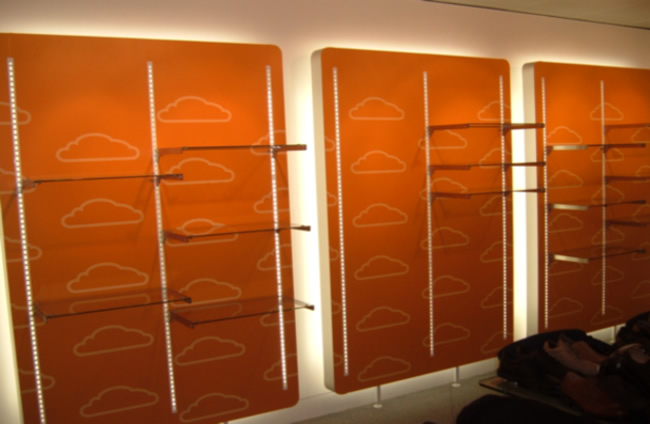
Follow the patient's eyes.
Sit in your own treatment chair, recline it, and notice what you can see. Often it is the operating light, a run of ceiling tiles and the top third of one wall. That is your real canvas. A calm image placed where a reclined patient's gaze lands gives them something to rest on, which is hard to achieve with a picture hung at normal height behind the dentist.
Ceiling-mounted prints are a popular idea for that reason, but anything above a patient has to be secure. Talk to your landlord and a qualified fitter before ordering, and tell us about the ceiling so the print can be planned around it.
Room by room
| Space | State of mind | What tends to work |
|---|---|---|
| Waiting room | Anticipation, sometimes real fear | Large, slow subjects such as landscape, water or trees |
| Treatment room | Lying still, unable to talk | One restful image in the line of sight |
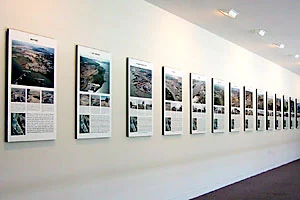
| Corridor | Moving past in seconds | A simple run of prints to soften a long wall |
| Children's corner | Bored and curious | Something to find or count, at a child's eye level |
| Reception | First impression | Your name, plainly done, and calm colour |
Subjects to leave out
Avoid close-ups of teeth, instruments and anything clinical in rooms where patients wait. Smile photographs belong in a treatment plan and not on the wall. Busy patterns, strong reds and dramatic weather also work against you. If you are not sure about an image, ask a nervous friend to sit with it for a minute.
Cleaning comes first in clinical rooms
Surfaces in a treatment room have to survive your cleaning routine, so the rule is smooth, sealed and wipeable, with few ledges. That usually rules out fabric and loose canvas, and it favours a print sealed or laminated onto a rigid board, or face-mounted on Perspex. Check any choice with whoever leads infection control at your practice, and against the guidance that applies to you. Tell us which disinfectant wipes you use. Harsh products can cloud acrylic or mark a laminate, so test on an offcut first.
Glare under clinical light
Dental rooms are brightly lit, and a gloss surface can bounce that light straight back. A matt laminate keeps an image readable from the chair. Acrylic has great depth, but it does reflect, so try the position with a sheet of glass or a mirror before committing.
A practical order of work
- Start with the waiting room, which every patient sees.
- Add one piece per treatment room.
- Finish with corridors, once the style is settled.
For wider ideas on seating areas, see healthcare waiting room graphics.
Calm, clean surfaces.

Your questions.
Can you print our own photographs of the local area?
Yes, as long as the files are big enough or you own the rights to the images. Familiar local views can be a good choice for a waiting room. Send them over and we will check the size.
Are framed pictures a problem in a treatment room?
Frames add ledges and joins that gather dust. Your infection control lead should have the final say, but a smooth rigid panel is usually simpler to keep clean.
Can we change the artwork later?
Yes, if it is fixed in a way that allows for it. Velcro or a simple hanging system makes a swap easy in non-clinical areas. Ask us about options for your walls.