
Framing large prints
A small frame is a decoration. A frame round an A0 print is a piece of furniture, with real weight, a real risk of breakage and a route to plan through the building.
Start with the glazing.
Nearly every other decision follows from this one. At small sizes glass is the easy default, but as the sheet gets bigger, so does its weight and the seriousness of a break.
| Glass | Acrylic | No glazing | |
|---|---|---|---|
| Weight | Heavy at large sizes | Much lighter | Lightest |
| If it breaks | Sharp shards | Hard to break, safer in public | Nothing to break |
| Surface | Hard, resists scratching | Scratches more easily, attracts dust | Print must be protected another way |
| Cleaning | Glass cleaner | Soft cloth, no ammonia products | As for the print |
| Good for | Fixed, quiet rooms | Large work, public spaces, moving work | Sealed or mounted prints, canvas |
In a school, surgery or corridor, ask whoever looks after the building whether there are rules on glazing. Do not assume that glass is permitted.
Keep the print away from the glazing.
A print pressed against glass can stick to it, especially a glossy photograph, and condensation can get trapped between them. A window mount or a thin spacer keeps a small gap. A mount also gives a large image some visual breathing space, though it adds to the overall size, so measure the wall against the outer dimensions.
Keeping a large sheet flat.
A loose A0 print will sag or ripple inside a frame as the air changes. For sizes around A1 and over, consider mounting it to a board first, using one of the lightweight boards. Foamex and Dibond are both used for this, and Dibond holds its shape better on the largest panels. Mounting is usually irreversible, so do not mount a one-off original. A limited edition print may also lose value if it is stuck down. Ask a framer who works with art.
A question of weight.
Add up the frame, the glazing, the backing and the print. Then think about who will be lifting it, and where it will hang.
- Plasterboard needs suitable fixings, or a fixing into the studs.
- Two fixing points are better than one and keep the frame level.
- A large frame is a two-person lift, even when it is not heavy, because it catches on everything.
- Measure doors, stairs and the lift before ordering. A frame cannot be folded.
Our part.
Framing is available on request and quoted per job, so tell us the size, the finish you have in mind and where it is going. If you are still weighing up the styles, start with framed print options. Tell us early if you want delivery, as framed work, especially with glass, needs careful handling.
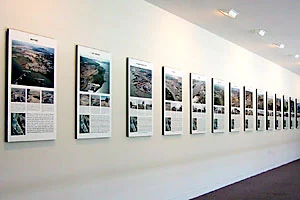
Framed work on walls.

Your questions.
Can I reduce reflections on a framed print?
Low-reflection glazing does exist, and it can help in bright rooms. Ask about options for your size, as large sheets may be limited.
Can you frame a print I already own?
Ask us. Tell us the size and what the print is, particularly if it is old or valuable.
How high should a large frame hang?
Start with the centre at around eye level. Very tall frames will sit lower, so the bottom edge stays a sensible distance from the floor.