
Board edges and how they look
Designers plan the face of a panel, then visitors walk past and see the side. Every board has a different edge, and a few minutes on this now will save a disappointment later.
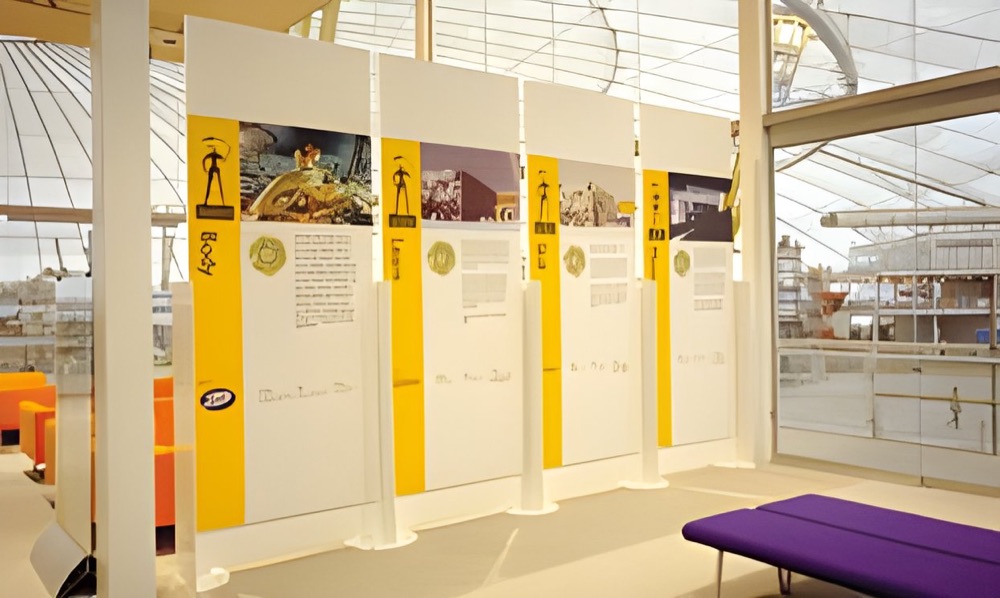
What you see from the side.
On most mounted work the print runs to the edge and is trimmed along with the board, so the cut edge is bare. The colour varies by the sheet supplied, so treat this as a general guide and ask us if a particular edge matters.
| Board | What you see | Best treatment |
|---|---|---|
| Foamex | A plain, smooth edge, usually white | Often fine as it is, and neat on thicker sheets |
| Polyboard | Foam centre sandwiched between thin paper faces | Keep it framed or out of sight if the job is formal |
| Dibond | Two fine lines of metal with a core between them | Clean and technical, suits a modern look |
| MDF | Matt, fibrous, brown-toned edge | Paint it, or set it into a frame or trim |
| Corex | Open ribbed channels along two sides | Fine for event signs, not meant for close viewing |
Why dark prints have a harder time
Pale edges and dark artwork are a bad match. A black poster on a white foam board shows a thin bright line round the outside, and on a wall of panels that line is the first thing you see. Also, knocks on the corners go white on dark prints, while the same damage on pale artwork hardly shows.
Your options
- Accept it. On a wall seen head on, a neat 3mm or 5mm edge disappears. This is the right call more often than people expect.
- Colour it. A darker edge can be achieved on some boards with paint or a marker, but it takes a careful hand. Try it on an offcut first, because a wobbly edge looks worse than a white one. Ask us whether this is something we can do on your job.
- Wrap it. Wrapped edges take the image round the side and are available on request. The artwork needs extra area to allow for that.
- Frame it. A slim frame covers the edge, protects corners and adds a line around the work. See framed print options.
- Make a feature of it. Thick 10mm board has a strong, deliberate edge. It reads like a block on the wall and casts a soft shadow.
Think about where people stand
Stand at the entrance to the space and picture the panels at the angle you will see them. Panels on a long wall are viewed side-on all the way down, so their edges show. Free-standing panels show all four. A piece over a reception desk is seen head on, and its edge barely matters.
Check it on the file too
A print trimmed flush to the edge needs bleed, or a tiny sliver of bare board can appear when the panel is cut. A fault like that looks like a board problem, but it starts in the artwork.
Corners
Square corners are sharp, and they catch on clothing and get damaged first. If a panel will be near people, ask us about the options before you finish your artwork.
Edges, frames and flat panels.
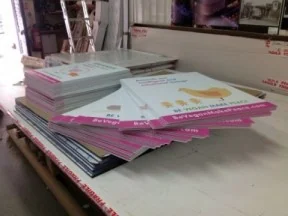

Your questions.
Can I have a black edge on a white board?
Ask us. Different sheets are made in different colours, and we can confirm what is possible for your size and board before you approve the job.
Do edges need sealing on outdoor boards?
It depends on the board. MDF should not be outside at all, and on the outdoor boards the concern is usually the print edge lifting. Tell us the site and we will advise.
Do I get a sample of the edge?
If the edge is important to your project, ask when you enquire. We can talk through the options and let you know what we can show you.