
Planning a mural layout
A printed mural is planned on paper before it exists on the wall. A scale drawing shows the problems early, while they still cost nothing to move.
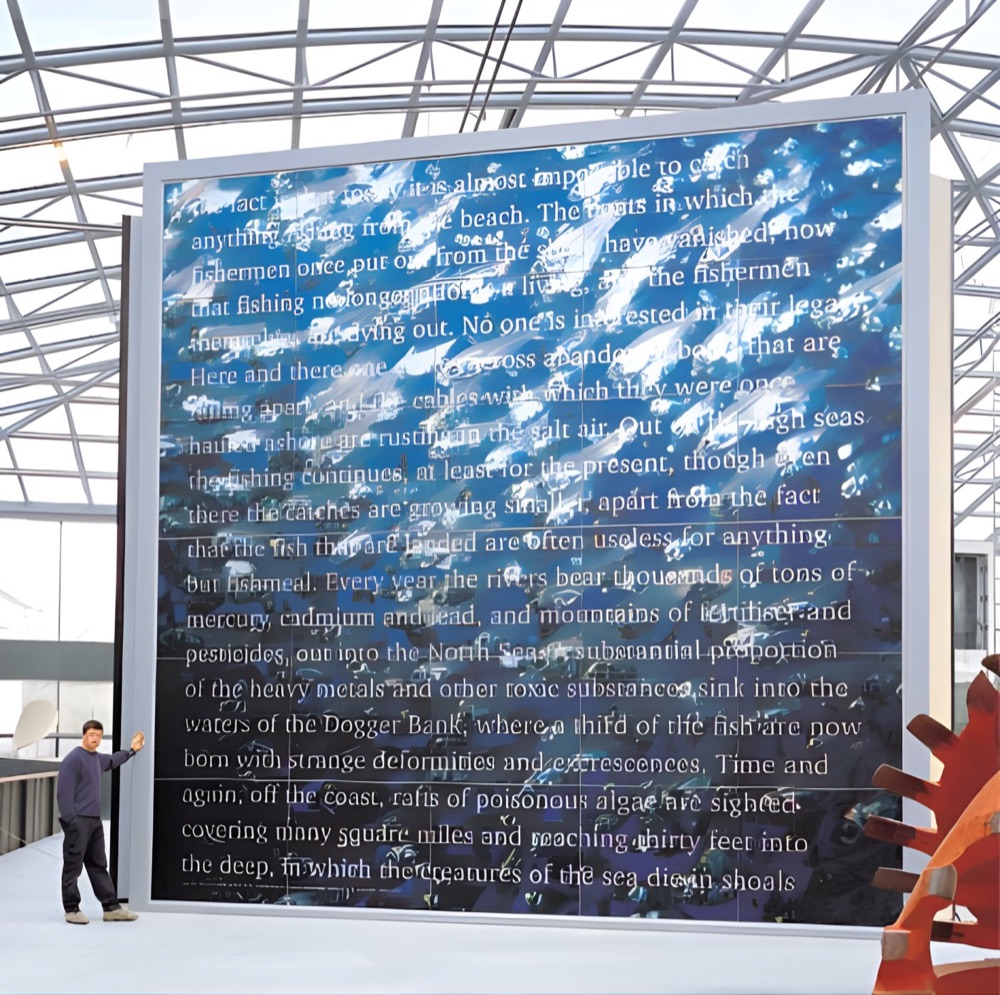
Draw the wall at 1:10.
Take your survey, then draw the wall on a sheet of paper, with one millimetre standing for ten. A wall 5400mm wide becomes a line 540mm long. Mark doors, sockets, radiators, and anything that stands in front of the wall. Then cut out your image at the same scale, or lay it over the drawing on screen, and start moving it around. If you have not surveyed the space yet, start with measuring a wall for a graphic.
Four layers of decisions.
1. What is hidden
Shade in the areas blocked by furniture, screens and seated people. In a café, the lower metre may never be seen. Do not spend the picture's best detail there. Use it for a simple continuation of the background.
2. Where the eye lands
The main subject belongs where people actually look: around eye level for standing visitors, and often slightly off-centre in the direction they walk. Think about the first view through the door. That is the shot that matters most, and it might be from an angle.
3. Where the joins fall
Most murals go up in vertical panels, and their width depends on the material. Say the panels were 1200mm wide. A 5400mm wall would then take four and a half panels, so you would order five and trim the last. Slide the grid across your drawing and check what each join passes through. Faces, eyes, small text and logos should sit inside a panel. Skies, plain walls and soft backgrounds are the places to let a join fall. Ask us for the real panel width for your material before you do this.
4. What happens at the edges
Allow extra image at each side for trimming, because walls are rarely straight. Anything that seems to line up with a door frame or a ceiling will reveal the fact that they are not square, so keep lines away from those edges if you can.
Check the image holds up.
Long walls need big files. At 5400mm, or about 213in, a picture at 50 pixels per inch needs about 10,600 pixels across, and that is only fine if people are a few steps away. In a corridor, where they brush past, you need far more. Our page on scaling artwork for large print explains how to judge this. Illustrations built as vector art have no such limit, and our design team can build a layout from your survey.
Try it at full size.
Before signing off, print or draw one section at full size and tape it to the wall. The scale of a face or a word is hard to judge in a small plan. It is common to find that a subject which looked modest on paper is two metres tall in the room.
| Check | Done when |
|---|---|
| Main subject | Clear from the door and not behind furniture |
| Joins | None through faces, logos or small text |
| Obstacles | Sockets and fittings marked on the artwork |
| Trim | Extra image included at the edges |
| Text | Readable from where people stand |
Long walls of print.
Your questions.
Can a mural go round a corner?
Yes. Plan a join at the corner if you can, so that the image does not have to bridge the angle, and check how the picture reads from both walls.
Should text be part of the mural?
Only if it will not change. Words that may go out of date are better added as separate vinyl lettering or a small panel.
Can I use a stock photo for a mural?
If its licence allows that use and the file is big enough. Check both before designing, as many web-sized files are too small.