
High-impact tape fixings
Strong double-sided tape can hold a rigid board with no visible fixings and no holes in the wall. It is best thought of as semi-permanent: easy to put up, and hard to take down.

Where it sits among your options.
High-impact tape is one of the fixings on our list. Tapes of this kind are thick and foam-like, and they bond a sign to a surface and stay put. Exact products vary, so ask us which one we would use for your job. Here is how it compares in general with the other routes.
| Fixing | Comes off easily? | Holes in the wall? | Best for |
|---|---|---|---|
| High-impact tape | No | No | Signs staying up for a long time |
| Velcro | Yes | No | Panels you swap or remove |
| Magnetic tape | Yes | No | Thin graphics on steel |
| Screws or stand-offs | With tools | Yes | Heavy boards, outdoor signs, anything overhead |
The bond is made before you press.
Nearly every tape failure traces back to the surface, not the tape. Dust, grease, damp and loose paint all come away, taking the sign with them. Before you fit a board:
- Clean the surface and let it dry fully. Ask us what to use on your particular finish.
- Check the paint is sound. If it flakes when you scratch it, the tape will only hold the top layer.
- Avoid fitting on a cold or damp day, since adhesives bond poorly on cold surfaces.
- Apply firm pressure across all the tape, not just the corners.
- Leave it alone. Many tapes build strength for some time after fitting, so give it as long as the maker advises before loading it or knocking it.
Good jobs for it.
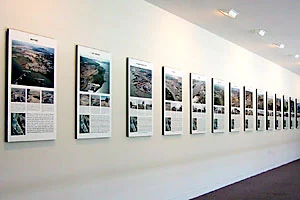
Office door and room signs. Rigid signs on tiled walls in a kitchen or washroom, where drilling would crack the tile. Panels on glass or a smooth partition. Printed boards in a corridor that will stay for a long period, as on our corridor displays page.
Poor jobs for it.
Textured plaster, unsealed brick and wallpaper give too little contact. Heavy boards such as MDF ask too much of it. Above all, anything over people's heads or on an escape route should have a mechanical fixing, approved by whoever is responsible for the building. Outdoor sign work is a separate question too, because of the wind, sun and rain. Talk to us about outdoor boards and how they are normally fixed.
Taking it down.
Plan for this at the start. Pulling a board off will usually bring paint or plaster with it. A thin wire or fishing line, worked behind the board like a saw, can part the foam, and the residue then needs careful cleaning. Expect some repair to a painted wall, and if you rent the building, ask the landlord first.
Boards fixed to walls and glass.

Your questions.
Can high-impact tape go on a freshly painted wall?
Wait until the paint has fully cured, following the paint maker's guidance. New paint can stay soft for some time, and a strong tape may pull it off.
Can a board fixed with tape be moved later?
Treat it as a one-way job. Once it has bonded, you are likely to damage either the wall or the board in removing it.
Does the tape show from the side?
A thick foam tape leaves a slim gap behind the board. Keep the strips set in from the edge, and it will be hard to see in normal viewing.